




Fast and predictable aesthetic correction of front teeth
Ceramic dental veneers are ceramic sheets that are placed on existing teeth, most often in the smile zone. They are individually shaped for each patient and are bonded to the front surface of the teeth. They are often used to enhance the beauty of a smile and are an excellent choice for patients who are dissatisfied with the shape, color, and size of their teeth.
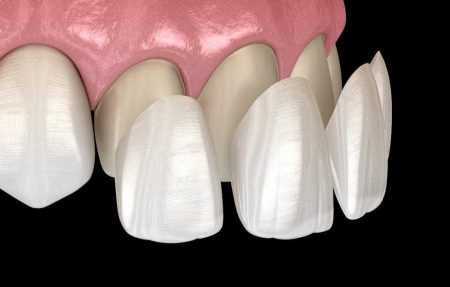
What defects can you fix with dental veneers?
Ceramic dental veneers can correct minor aesthetic defects such as:
-
- tooth wear
- darkened and stained teeth
- irregular position, e.g. slightly rotated or crooked teeth
- gaps between teeth
- chipped and otherwise damaged teeth
- adding volume to teeth
What are dental veneers made of?
Although there are other types of veneers, such as composite veneers, at Apolonija Dental Clinic we only place ceramic dental veneers.
They have many advantages in terms of quality, appearance and durability:
- Ceramic veneers last for many years and keep their appearance.
- Ceramic dental veneers do not absorb pigments from food and drinks, so they will remain white for a long time.
- Ceramic dental veneers have a high shine and completely recreate the natural beauty of teeth.
Veneers require grinding of the front surface of the tooth, which is irreversible, because the tooth will always need some kind of restoration afterwards. With good hygiene and protection against teeth grinding, ceramic veneers last for years, but not for a lifetime; over time they need to be replaced. That is why, before deciding, we always check whether a more conservative solution exists: with misaligned teeth, orthodontic treatment often reduces the amount of grinding needed, and sometimes makes veneers unnecessary.
Veneers cannot be placed immediately if:
1) your teeth have been reconstructed with fillings
A problem with placing ceramic dental veneers can be fillings. If they take up a large part of the tooth, we cannot place veneers and a ceramic crown will need to be made.
2) you have cavities or inflammation
Furthermore, the teeth must be healthy, without cavities. The dentist will thoroughly examine your teeth and make a conclusion about whether you can have veneers placed. Once the teeth have healed, it is usually possible to have dental veneers placed.
3) you grind your teeth – bruxism
Teeth grinding can damage or even break off veneers. Therefore, before having them fitted, we must determine whether this harmful habit is present.
4) you have receding gums – enlargement of the tooth crown
Sometimes the gingiva is extremely lowered over the tooth, so before veneers it is necessary to equalize the height of the gingiva on each tooth. This is a procedure to enlarge the crown of the tooth (gingivectomy). Gingivectomy is a routine and safe method that we perform at Apolonija with a laser.
Laser removal of excess gums does not have a harmful effect on the surrounding tissues, is very selective, does not cause bleeding and gives a predictable result.
How are ceramic dental veneers placed?
Step 1: Preparing teeth for veneers
The tooth must be prepared for veneer bonding by grinding. The amount of tooth that needs to be ground down depends on what you want to achieve with the ceramic veneers. For example, if you want to add volume to the tooth, less grinding is needed than when changing the angle or color of the tooth.
Grinding is minimally invasive. The procedure is performed under local anesthesia, so the patient does not feel any pain during grinding.
Step 2: Taking an impression
We then take a digital impression of your teeth. Based on this, we will create veneers in the dental laboratory. We place temporary veneers on your teeth to protect them.
Step 3: Placing ceramic veneers
Ceramic dental veneers will be made within a few days. Before the veneers are permanently fixed, we will check with the patient to see if they are satisfied with the shade and shape of the veneers. Then the veneers are cemented.
Book a consultation with our dentists so we can assess your condition, listen to your wishes, and recommend a solution that will give you the smile you want.
Frequently asked questions
Does it hurt? — Grinding is performed under local anaesthesia and is not painful.
Can veneers fall off? — Rarely, and if they do, they are cemented again. The most common cause of damage is teeth grinding, which is why we recommend a protective night guard with veneers.
Veneers or orthodontics? — If the problem is the position of the teeth, orthodontics is more conservative because it requires no grinding. Veneers address colour, shape and minor irregularities.
Can veneers be removed? — Not without a new restoration, because the tooth has been ground down. That is why we always show the alternatives before deciding.
Systematic reviews and meta-analyses
Klein P et al. (2025). Survival and complication rates of feldspathic, leucite-reinforced, lithium disilicate and zirconia ceramic laminate veneers: a systematic review and meta-analysis. J Esthet Restor Dent. Twenty-nine studies and the most recent pooled data. After a mean of 10.4 years, survival was 96.13% for feldspathic ceramic, 93.70% for leucite-reinforced glass-ceramic and 96.81% for lithium disilicate, with no difference between materials. Lithium disilicate had the lowest complication rates (6.1% technical), while feldspathic veneers had the highest (41.48%). https://pubmed.ncbi.nlm.nih.gov/39523553/
Morimoto S et al. (2016). Main clinical outcomes of feldspathic porcelain and glass-ceramic laminate veneers: a systematic review and meta-analysis of survival and complication rates. Int J Prosthodont. The most frequently cited systematic review of ceramic veneer outcomes, with pooled data on survival and types of complications. https://pubmed.ncbi.nlm.nih.gov/26757327/
Alqutaibi AY et al. (2025). Clinical survival and complication rate of ceramic veneers bonded to different substrates: a systematic review and meta-analysis. J Prosthet Dent. Veneers bonded to enamel showed higher survival and success rates and fewer complications and failures than those bonded to dentin or to teeth with existing composite fillings. The best evidence for minimally invasive, enamel-preserving preparation. https://pubmed.ncbi.nlm.nih.gov/38604905/
Alenezi A et al. (2021). Long-term survival and complication rates of porcelain laminate veneers in clinical studies: a systematic review. J Clin Med. A review of long-term clinical studies on the survival and complications of porcelain veneers. https://pubmed.ncbi.nlm.nih.gov/33807504/
Layton DM et al. (2013). A systematic review and meta-analysis of the survival of non-feldspathic porcelain veneers over 5 and 10 years. Int J Prosthodont. A meta-analysis of the five- and ten-year survival of veneers not made of feldspathic ceramic. https://pubmed.ncbi.nlm.nih.gov/23476903/
Book an appointment at Apolonija Dental Clinic by phone, via WhatsApp or using the contact form.
+385 1 4883 800 +385 91 4883 800