




Orthodontic treatment does not end when the braces come off. At that point the teeth are in the right position, but the tissues around them are not yet stable. Retention is the phase in which we consolidate and preserve that result, and it is just as important as everything that comes before it.
Why do teeth want to move back to their old position?
After teeth have been moved, the bone remodels relatively quickly, but the elastic fibres in the gums remember the previous position and pull the tooth back for months. Other factors also play a role:
- the balance of the tongue, lips and cheeks — a tooth permanently stays where the forces of the soft tissues cancel each other out, so habits and muscle tone affect stability
- the bite — stable, even contact between the teeth is the best protection against relapse
- late changes in the dentition — mild crowding of the lower front teeth is a natural process that continues throughout life, even in people who have never worn braces
That is why we do not see retention as an add-on, but as an integral part of treatment. Because the tissues need time to stabilise after the braces are removed, retention is considered a mandatory procedure.
Types of retention: removable and fixed
Removable retainer
A thin, clear aligner made from an impression of your teeth. The patient removes and inserts it themselves; it is worn at night, and less often over time. Its advantage is that it covers all the teeth and preserves both the position of the back teeth and the height of the bite.
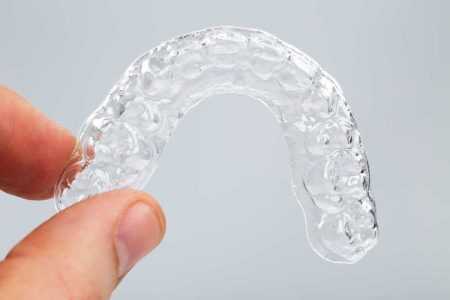
Removable retainer
Fixed retainer (wire behind the teeth)
A thin, individually shaped wire bonded to the inner surface of the front teeth. It is invisible, does not interfere with speech or eating, and works continuously — without relying on the patient to put it in. This is why it is the first choice where the tendency to relapse is more pronounced, especially in the lower jaw.
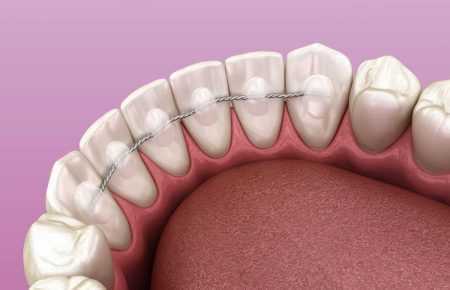
Fixed retainer
Combination
The most common solution: a fixed retainer on the front teeth and a removable one over it at night. The combination protects both individual teeth and the whole arch. Which type you will wear is decided by the orthodontic specialist based on the initial malocclusion, the condition of the gums and how much the teeth were moved.
How long does retention last?
The retention programme at our clinic lasts 18 months. This is the period during which we see you for regular check-ups, monitor the position of your teeth and correct minor deviations as they appear. It is also when the tendency to relapse is greatest.
Wearing a retainer lasts longer than the programme. A fixed retainer usually stays on the teeth after the programme ends, and a removable one is worn at night, less often over time. To put it plainly: no protocol in the world guarantees that teeth will stay put forever without a retainer. Teeth are living tissue in a living environment and they change with age. A retainer is a simple and inexpensive way to keep your result for good.
How to care for your retainer
Fixed retainer. Plaque and tartar build up faster around the wire than elsewhere, so in addition to a toothbrush you need superfloss or an interdental brush. We recommend professional cleaning twice a year.
Removable retainer. Rinse it with cold water and clean it with a soft brush without toothpaste. Hot water deforms the aligner. When it is not in your mouth, keep it in its case. The most common way a retainer goes missing is wrapped in a napkin on a restaurant table.
If your retainer comes loose, breaks or gets lost, get in touch with us. Teeth start to move within a few weeks. With a partially detached wire, movement can go unnoticed, so report even the smallest change in how it feels without waiting for your next check-up.
Did you wear braces elsewhere?
We also take over retention for patients who completed their orthodontic treatment at another practice. If your retainer has come loose, you have lost your aligners or you are not sure whether your teeth are still in the right position, come in for an examination and we will assess the situation and propose a solution.
Frequently asked questions about retention
Does fitting a retainer hurt? No. Bonding the fixed wire and taking an impression or scan for the aligners are completely painless and take one visit.
Does a fixed retainer affect speech? For the first few days your tongue notices the wire, after which you stop paying any attention to it. Speech does not change.
Do I have to wear a removable retainer for the rest of my life? Not all day — but in the long term, a few nights a week. If you stop wearing your retainer, your teeth may shift slightly over the years. Small changes can also be corrected later with a few A+ aligners.
What if I stopped wearing my aligners a few years ago? Come in for an examination. If the shift is small, a new retainer or a short correction is often enough. The longer you wait, the more extensive the solution.
Can I whiten my teeth with a fixed retainer? Yes. The wire is on the inside and does not interfere with whitening.
Will my teeth move back if the retainer comes loose on one tooth? That particular tooth may shift, sometimes without you noticing. That is why a partially detached wire means you should come in.
Does a retainer affect the gums? Not in itself. With poor hygiene around the wire, gum inflammation and tartar can develop, which is resolved with regular cleaning.
We want you to enjoy the lasting results of our treatment and be proud of a beautiful smile for years to come, with a retainer that protects your result!
Book an appointment at Apolonija Dental Clinic by phone, via WhatsApp or using the contact form.
+385 1 4883 800 +385 91 4883 800