




What is a fixed prosthesis on implants, All-on-4?
The All-on-4 method is an implant therapy that combines prosthetic work in the form of complete dentures and dental implants. It is also a complete dental rehabilitation that relies on 4 dental implants, and replaces all the teeth of one jaw.
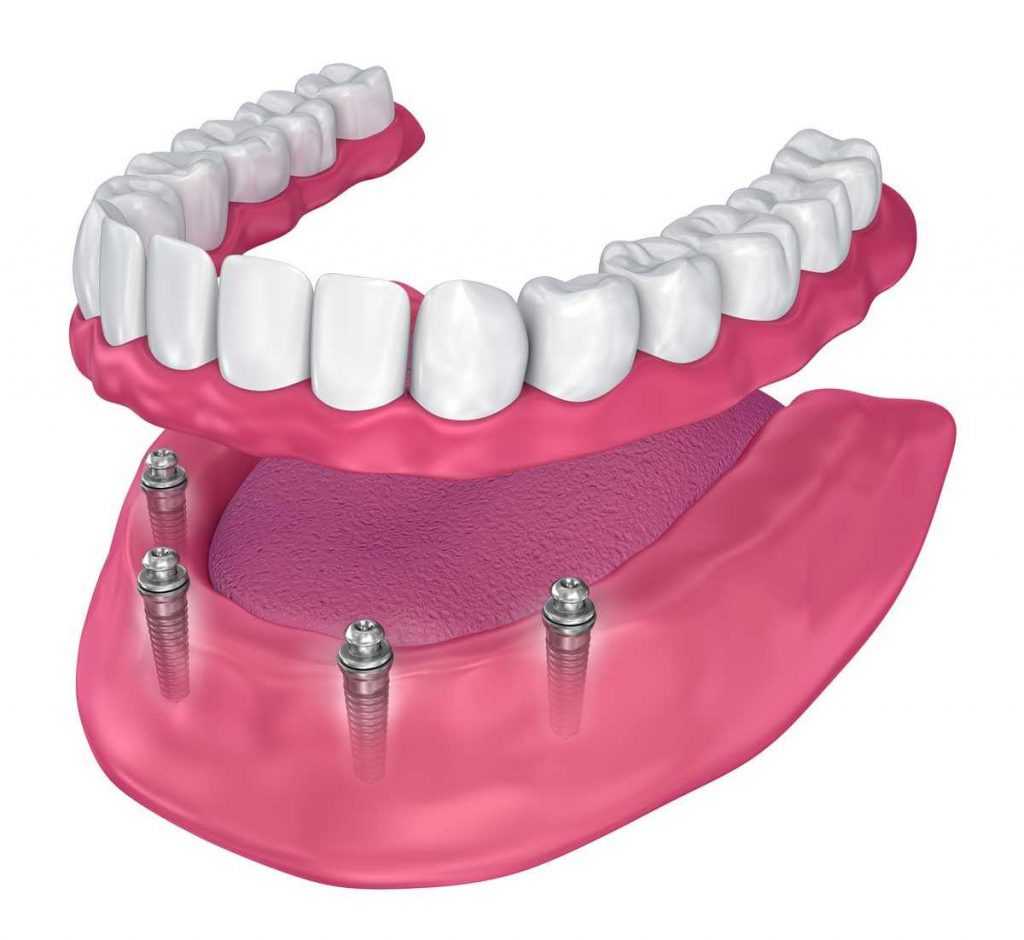
How does All-on-4 work?
For All-on-4, we place two dental implants in the anterior region and two in the posterior region.
The latter are placed at a 30–45° angle, which ensures the stability of the connected system. This arrangement of implants makes use of the largest available volume of the jaw ridge, which is important for the distribution of chewing forces on the bone.
Dental implant placement is performed under local anesthesia or sedation. The patient can return to daily activities the very next day after the temporary prosthetic work is fixed.
Advantages of All-on-4 compared to classic dental prosthesis
Traditional dentures use the remaining teeth, gums, and palate as support, while the implant-prosthetic solution, All-on-4, uses dental implants for support. Because the load is transferred to the jawbone, dental implant systems do not cause jaw resorption as is the case with dentures.
All-on-4 has the following advantages:
- feeling like you have natural teeth
- free palate and no denture mobility
- greater stability compared to a classic dental prosthesis
- longer durability of prosthetic work – with proper maintenance, All-on-4 can last much longer than dentures
- a more natural feeling when speaking and chewing: dental implants allow for faster adaptation and are as stable as natural teeth
Because of all of the above, there are a large number of patients who, after many years of using classic dentures, decide to replace them with an implant-supported bridge, All-on-4.
The concept of implant-supported dentures, All-on-4, is truly a revolution for patients who have lost their teeth. It is a return to a natural smile, natural chewing and a complete departure from the feeling of having lost teeth. All-on-4 is truly a complete rehabilitation and the beginning of a new quality of life for our patients.
Guidelines, consensus reports and official positions of professional societies
ITI (International Team for Implantology) consensus statements: Loading Protocols for Fixed Prostheses in Edentulous Jaws. Immediate, early and conventional loading with a one-piece fixed provisional prosthesis show high implant and prosthesis success rates and can be recommended for both the upper and the lower jaw. The number, size and distribution of implants for a full-arch fixed prosthesis must be determined by the prosthetic plan, arch shape and bone volume, regardless of the loading protocol. Primary implant stability is key to predictable osseointegration. https://www.iti.org/academy/consensus-database/consensus-statement/-/consensus/loading-protocols-for-fixed-prostheses-in-edentulous-jaws/1313
Schwarz F et al. (2026). First Global Consensus for Clinical Guidelines: Structured Recommendations (S2k-Level Guideline Framework) for the Rehabilitation of the Edentulous Maxilla Based on Core Outcome Sets. Clin Oral Implants Res. The first global consensus guideline for the rehabilitation of the edentulous upper jaw, developed jointly by the European Association for Osseointegration (EAO), the ITI and the Osteology Foundation. The recommendations cover the entire course of treatment, from patient selection to long-term maintenance, with an emphasis on individualised oral hygiene instruction and regular check-ups for early detection of prosthesis wear and prevention of mechanical complications. https://onlinelibrary.wiley.com/doi/10.1111/clr.70084
Schwarz F et al. (2021). Recommendations for implant-supported full-arch rehabilitations in edentulous patients: The Oral Reconstruction Foundation Consensus Report. Int J Prosthodont. Consensus recommendations of six Oral Reconstruction Foundation working groups, with a decision tree for choosing the type of restoration and medical, geriatric and anatomical criteria for planning. https://pubmed.ncbi.nlm.nih.gov/33571323/
Morton D et al. (2023). Group 5 ITI Consensus Report: Implant placement and loading protocols. Clin Oral Implants Res 34(Suppl 26). Report of the 7th ITI Consensus Conference in Lisbon on implant placement and loading protocols, bringing together patient selection criteria for accelerated protocols. https://onlinelibrary.wiley.com/doi/10.1111/clr.14137
Herrera D et al. (2023). Prevention and treatment of peri-implant diseases — The EFP S3 level clinical practice guideline. J Clin Periodontol. The highest-level (S3) guideline of the European Federation of Periodontology on the prevention and treatment of peri-implant mucositis and peri-implantitis; the basis for the maintenance and check-up protocol after All-on-4 treatment. https://onlinelibrary.wiley.com/doi/10.1111/jcpe.13823
Systematic reviews and meta-analyses
Shao WH et al. (2026). All-on-4 and All-on-6 implant-supported fixed prostheses for the edentulous jaw: a systematic review and meta-analysis. Int J Oral Maxillofac Surg. Fifty-five studies. The pooled survival rate after 1 year was 99.20% for All-on-4 and 100% for All-on-6, and after 5 or more years 98.14% for All-on-4 and 97.50% for All-on-6. Marginal bone loss after 5 years was 1.28 mm and 0.94 mm, respectively. Mechanical complications were recorded in 5.91% (All-on-4) and 6.64% (All-on-6), and biological complications in 6.54% and 7.41%, respectively. Both techniques give comparable results. https://www.sciencedirect.com/science/article/pii/S0901502726001402
Del Fabbro M et al. (2022). Outcomes of fixed full-arch rehabilitations supported by tilted and axially placed implants: a systematic review and meta-analysis. Int J Oral Maxillofac Implants. A systematic review of the outcomes of fixed full-arch rehabilitations supported by a combination of tilted and axial implants. https://pubmed.ncbi.nlm.nih.gov/36170316/
Gaonkar S et al. (2021). Survival rates of axial and tilted implants in the rehabilitation of edentulous jaws using the All-on-four concept: a systematic review. J Indian Prosthodont Soc. The cumulative implant survival rate over 6 to 11 years was 94% to 98%, and prosthesis survival after 12 months was 99% to 100%. Mean bone loss was 1.3 ± 0.4 mm. No significant difference in survival was found between axial and tilted implants or between the upper and lower jaw. https://pubmed.ncbi.nlm.nih.gov/33835063/
Malak AA et al. (2024). Implant failure and marginal bone loss between axial and tilted implants: an umbrella review with meta-analysis. Int J Oral Maxillofac Implants. An umbrella review of systematic reviews. In the long term, a statistically significant difference in marginal bone loss was found between axial and tilted implants, but it amounts to only 0.18 mm, which is considered clinically negligible and does not affect implant survival. https://doi.org/10.11607/jomi.10885
Häggman-Henrikson B et al. (2024). Bruxism and dental implants: a systematic review and meta-analysis. J Oral Rehabil. Implants placed in patients with bruxism have a higher risk of failure than in those without bruxism. Relevant because bruxism is common in patients presenting for All-on-4 treatment, and it justifies a mandatory night guard. https://onlinelibrary.wiley.com/doi/10.1111/joor.13567
Mustapha AD et al. (2021). Smoking and dental implants: a systematic review and meta-analysis. Medicina 58:39. Smoking is associated with a substantially higher risk of implant loss compared with non-smokers, which justifies advising patients to stop smoking before the procedure. https://pubmed.ncbi.nlm.nih.gov/35056347/
Long-term clinical studies
Maló P et al. (2019). The All-on-4 treatment concept for the rehabilitation of the completely edentulous mandible: a longitudinal study with 10 to 18 years of follow-up. Clin Implant Dent Relat Res. The longest published follow-up of the All-on-4 concept in the lower jaw, with an implant survival rate of about 93% after 18 years. https://pubmed.ncbi.nlm.nih.gov/30924309/
Maló P et al. (2019). The All-on-4 concept for full-arch rehabilitation of the edentulous maxillae: a longitudinal study with 5–13 years of follow-up. Clin Implant Dent Relat Res. The corresponding follow-up in the upper jaw, with an implant survival rate of 94.7% over 13 years. https://doi.org/10.1111/cid.12771
Uesugi T et al. (2023). The All-on-four concept for fixed full-arch rehabilitation of the edentulous maxilla and mandible: a longitudinal study in Japanese patients with 3–17-year follow-up and analysis of risk factors for survival rate. Int J Implant Dent. Long-term follow-up with an analysis of risk factors for implant survival with immediate loading in both jaws. https://www.ncbi.nlm.nih.gov/pmc/articles/PMC10632321/
La Monaca G et al. (2022). Immediate flapless full-arch rehabilitation of edentulous jaws on 4 or 6 implants according to the prosthetic-driven planning and guided implant surgery: a retrospective study on clinical and radiographic outcomes up to 10 years of follow-up. Clin Implant Dent Relat Res 24:831–844. A direct comparison of rehabilitations on four and on six implants with guided surgery, with a cumulative survival rate of 89.7% for implants and 88.2% for prostheses in the All-on-4 group after 10 years. https://doi.org/10.1111/cid.13134
Prosthetic complications and materials
Papaspyridakos P et al. (2025). Zirconia full-arch implant prostheses: survival, complications, and prosthetic space dimensions with 115 edentulous jaws. J Prosthodont. One hundred and fifteen monolithic zirconia full-arch fixed prostheses followed for up to 6 years, with a prosthesis survival rate of 98.6%. The most common minor complications were loss of the screw access channel filling and ceramic chipping. https://onlinelibrary.wiley.com/doi/10.1111/jopr.13922
Papaspyridakos P et al. (2020). Technical complications and prosthesis survival rates with implant-supported fixed complete dental prostheses: a retrospective study with 1- to 12-year follow-up. J Prosthodont. A review of technical complications of full-arch fixed prostheses over a period of up to 12 years; useful as a realistic picture of the maintenance to be expected. https://pubmed.ncbi.nlm.nih.gov/31650669/
Function and patient-reported outcomes
Gonçalves GSY et al. (2022). Oral health-related quality of life and satisfaction in edentulous patients rehabilitated with implant-supported full dentures all-on-four concept: a systematic review. Clin Oral Investig. A systematic review of oral health-related quality of life and patient satisfaction after rehabilitation with the All-on-4 concept. https://doi.org/10.1007/s00784-021-04213-y
Sulaiman MA, Kriauciunas A (2025). Analysis of masseter muscle activity following treatment of fully edentulous patients with mono-arch and bi-arch All-on-4 prostheses: a systematic literature review. All included studies consistently show increased masseter muscle activity after rehabilitation with an All-on-4 prosthesis compared with other types of restoration, confirming improved chewing function. https://www.ncbi.nlm.nih.gov/pmc/articles/PMC12539608/
Book an appointment at Apolonija Dental Clinic by phone, via WhatsApp or using the contact form.
+385 1 4883 800 +385 91 4883 800