




The loss of all teeth is one of the biggest dental problems and as such significantly affects the quality of life. A classic removable denture will solve this problem if we cannot apply a better implant solution (such as All-on-4) or as a more economical option.
What Types of Removable Dentures Exist?
Dentures are classified as removable prosthetic works. This means they are not permanently fixed, and the patient can remove and replace them in the mouth.
We divide them into solutions that replace all teeth in the jaw, called total or complete dentures, and solutions that replace individual teeth, called partial dentures.
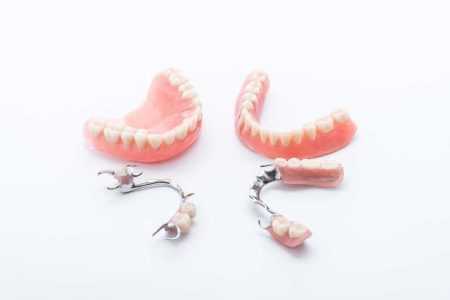
Complete and partial dentures
There are also fixed dentures, which fall under implant-prosthetic solutions, as they combine dental implant placement and prosthetic work. This is the All-on-4 implant solution, about which you can learn more on the page All-on-4 fixed dentures.
Total or Complete Removable Dentures
A total denture replaces all teeth in one jaw. The base of the total denture is made of acrylic, a type of light, biocompatible material that has been used in dentistry for many years. Artificial teeth are embedded in the base. In addition to having the appropriate physical and chemical properties for long-term use and durability, the acrylic denture also has the necessary aesthetic properties and imitates the color of the gum tissue it partially replaces.
To remain attached to the jaw, the acrylic base uses a system of adhesion forces between the base and the soft tissues of the palate, jaw ridge, and tissues under the tongue. At a professional level, this is a challenge, so the production of removable dentures is considered a procedure that requires prosthetic knowledge and an individual approach in the manufacture of prosthetic replacement. As much as a total or partial denture is an economic category, to be a quality and successful solution, it requires special knowledge and skills in its production.
Apolonija Dental Clinic is proud of the procedures and methods it applies in the production of removable dentures. Removable dentures are among the most demanding professional procedures because they require exceptional knowledge and skills.
The protocols we implement in the production of complete removable dentures rely on traditional protocols of German and Swiss dentistry that Dr. Mira Jukić-Lauc introduced into everyday practice back in the 1960s. At that time, implants did not exist, and the art and knowledge of removable prosthetics were the only guarantee of the success of such prosthetic works.
There are procedures that are contemporary and modern, and there are procedures that are traditional. And in some things, how it was done fifty or more years ago was better and more successful. Because there were no alternatives and because patients needed to be given the best.
Our goal is a denture that holds well on its own, without denture adhesives. This is achieved through a precise impression, careful bite registration and a larger number of try-ins than is usual.
The Process of Making a Total Denture
It will take 15-30 days to make a total or complete denture. The procedure also requires you to come to our clinic 6 to 10 times during the manufacturing process. Our procedures are certainly longer than standard ones, with more visits and much more attention and care to ensure the best possible result.
Tradition of Quality at Apolonija Dental Clinic
In addition, we want to emphasize that at Apolonija Dental Clinic, we follow a prosthetic protocol that will guarantee high quality of the denture in terms of function and aesthetics.
We proudly highlight the special methodology for making dentures inherited from Dr. Mira Jukić-Lauc, who for many years was one of the leading experts in denture making in Croatia.
Because we respect traditional rules and approach each denture completely individually, our patients have been happily wearing their new and beautiful teeth for many years.
Disadvantages of Total Dentures
Although a complete denture is a quality and affordable solution for the lack of all teeth, it should be emphasized that dentures do not have a positive effect on bone like dental implants do.
This means that the bone resorbs and decreases due to wearing the denture. For this reason, the denture becomes uncomfortable and needs to be regularly relined.
Guidelines, consensus reports and official positions of professional societies
Thomason JM et al. (2009). Mandibular two implant-supported overdentures as the first choice standard of care for edentulous patients — the York Consensus Statement. Br Dent J. A consensus of the British Society for the Study of Prosthetic Dentistry, prepared as a follow-up to the 2002 McGill statement. There is a large body of evidence supporting the position that a two-implant overdenture in the lower jaw should be the minimum offered to edentulous patients as the first choice of treatment, instead of a conventional complete denture. https://www.nature.com/articles/sj.bdj.2009.728
Thomason JM et al. (2012). Two implant retained overdentures — a review of the literature supporting the McGill and York consensus statements. J Dent. A review of the evidence underpinning the McGill and York consensus statements, with data on patient satisfaction, quality of life, chewing function and costs. https://www.sciencedirect.com/science/article/pii/S0300571211002132
Schwarz F et al. (2021). Recommendations for implant-supported full-arch rehabilitations in edentulous patients: the Oral Reconstruction Foundation Consensus Report. Int J Prosthodont. Consensus recommendations from six working groups, with a decision diagram for choosing between removable and fixed restorations and medical, geriatric and anatomical criteria for planning. https://pubmed.ncbi.nlm.nih.gov/33571323/
Schwarz F et al. (2026). First global consensus for clinical guidelines: structured recommendations for the rehabilitation of the edentulous maxilla based on core outcome sets. Clin Oral Implants Res. A joint guideline of the EAO, the ITI and the Osteology Foundation covering both removable and fixed restorative options in the edentulous upper jaw. https://onlinelibrary.wiley.com/doi/10.1111/clr.70084
Book an appointment at Apolonija Dental Clinic by phone, via WhatsApp or using the contact form.
+385 1 4883 800 +385 91 4883 800