




A dental crown is a prosthetic replacement that is placed on the upper visible part of the tooth (the crown of the tooth) or on a dental implant. It is most often used to strengthen and cover a damaged, weakened or aesthetically unattractive tooth. A crown restores the natural shape, size and function of the tooth. They are made of different materials, and the choice depends on the position of the tooth, as well as functional and aesthetic requirements.
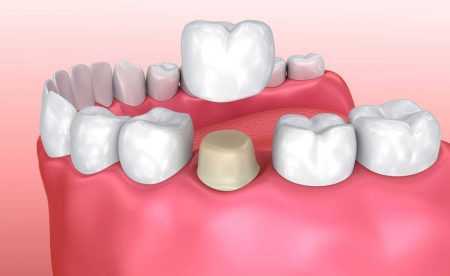
When do you need a dental crown?
- When your tooth is weakened (e.g. after major caries and root canal treatment)
- When you need to restore a severely damaged or worn tooth
- When you want to improve the appearance of your teeth (color, shape, position)
- When you had a dental implant placed
- When you need to replace a lost tooth (when one or more teeth are missing)
Book an appointment at Apolonija Dental Clinic by phone, via WhatsApp or using the contact form.
Natural-looking crowns
Dental crowns that look just like natural teeth are achievable.
Although we rarely think about it, a natural tooth combines exceptional optical properties. Over 50 years of experience in dental prosthetics, we have developed precise procedures using modern technologies to achieve a perfectly natural appearance of dental crowns, just as if it were a natural tooth. We use proven ceramic and zirconia materials from leading manufacturers.
At Apolonija Dental Clinic, we use the third, latest generation of zirconia dental ceramics. This allows us to imitate the color of the patient’s existing teeth or the desired shade with great precision, while also guaranteeing the durability of the crown’s appearance.
Earlier generations of zirconia-ceramic dental crowns tended to lose their shade due to wear. With the latest generation of zirconia, that problem has been eliminated.
A dental crown in one day
Did you know that you can get a functionally and aesthetically precise dental crown within a single day?
We manufacture your individual crowns using advanced CEREC CAD/CAM technology. The process begins with a digital impression taken using a 3D intraoral scanner. The precisely mapped details of the tooth and surrounding tissue are immediately transferred to the software, where a zirconia crown is designed with maximum precision, taking into account biological characteristics and aesthetic and functional requirements. A robotic system then precisely manufactures the ceramic crown.
Materials for dental crowns:
Emax and empress crowns
Emax and Empress crowns are considered to be the most faithful reproductions of natural teeth, and have been used in dental prosthetics for decades. Due to their unquestionable beauty, they are most often recommended for replacing front teeth, popularly known as the “smile zone”.
Full zirconia crowns
Full zirconia crowns are recommended for the posterior region because they have proven to have exceptional physical and mechanical properties where chewing forces are strongest.
Zirconia-ceramic crowns
Zirconia-ceramic crowns are recommended for the smile region and also for the back teeth, as they have excellent mechanical properties and pronounced shine and light transmission.
When do you need a dental bridge?
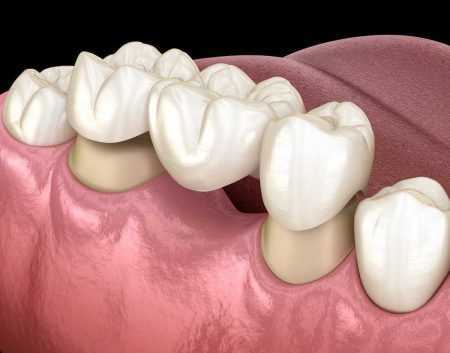
A dental bridge is actually a series of dental crowns connected into one prosthetic work. If you are missing one or several teeth in a row, we can replace them with a dental bridge.
A dental bridge must be supported by abutment teeth or implants. In addition to replacing lost teeth, dental bridges are sometimes placed to strengthen unstable periodontally compromised teeth.
Frequently asked questions
Does the tooth have to be ground down? — For a crown, yes. How much depends on the material and the condition of the tooth.
Bridge or implant when a single tooth is missing? — A bridge requires grinding down the neighbouring teeth, an implant does not. If the neighbouring teeth are healthy, an implant is usually the more conservative option.
Can a crown be whitened? — No. The shade is chosen before the crown is made, so we plan any whitening before the prosthetic work.
Systematic reviews and meta-analyses — crowns
Sailer I et al. (2015). All-ceramic or metal-ceramic tooth-supported fixed dental prostheses (FDPs)? A systematic review of the survival and complication rates. Part I: single crowns. Dent Mater. Seventy-one studies. The five-year survival was 94.7% for metal-ceramic crowns, 96.6% for lithium disilicate glass-ceramic crowns and 92.1% for densely sintered zirconia crowns. Feldspathic ceramic crowns had significantly lower survival, especially in the posterior region, so they are recommended for anterior teeth only. https://pubmed.ncbi.nlm.nih.gov/25842099/
Pjetursson BE et al. (2018). A systematic review of the survival and complication rates of zirconia-ceramic and metal-ceramic single crowns. Clin Oral Implants Res. A review prepared for the 2018 ITI Consensus Conference, comparing zirconia-ceramic and metal-ceramic single crowns and analysing technical complications such as veneering ceramic chipping. https://onlinelibrary.wiley.com/doi/10.1111/clr.13306
Jung RE et al. (2012). Systematic review of the survival rate and the incidence of biological, technical, and aesthetic complications of single crowns on implants reported in longitudinal studies with a mean follow-up of 5 years. Clin Oral Implants Res. The reference review for single crowns on implants, with data on biological, technical and aesthetic complications over five years. https://pubmed.ncbi.nlm.nih.gov/23062124/
Systematic reviews and meta-analyses — bridges
Sailer I et al. (2007). A systematic review of the survival and complication rates of all-ceramic and metal-ceramic reconstructions after an observation period of at least 3 years. Part II: fixed dental prostheses. Clin Oral Implants Res. The five-year survival of metal-ceramic bridges was 94.4%, significantly higher than 88.6% for all-ceramic bridges. Framework and veneer fractures were considerably more frequent with all-ceramic bridges (6.5% and 13.6%) than with metal-ceramic ones (1.6% and 2.9%). https://pubmed.ncbi.nlm.nih.gov/17594373/
Pjetursson BE et al. (2007). Comparison of survival and complication rates of tooth-supported fixed dental prostheses (FDPs) and implant-supported FDPs and single crowns (SCs). Clin Oral Implants Res. A direct comparison of the five- and ten-year survival of bridges on natural teeth with bridges and crowns on implants, including biological and technical complications. Useful for explaining to patients when a tooth-supported bridge is a better choice than an implant. https://pubmed.ncbi.nlm.nih.gov/17594374/
Book an appointment at Apolonija Dental Clinic by phone, via WhatsApp or using the contact form.
+385 1 4883 800 +385 91 4883 800