




Tooth repair is the most common dental procedure. It consists of caries removal and tooth reconstruction with permanent and aesthetic material.
How does caries occur?
Dental caries is one of the most widespread diseases today. It is an infectious disease caused by the action of cariogenic bacteria in the oral cavity.
The metabolic product of cariogenic bacteria is acid that destroys enamel and dentin and penetrates the center of the tooth, leading to its complete decay.
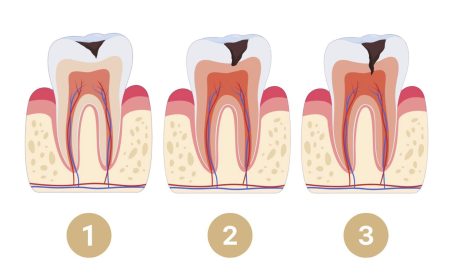
Composite fillings – white fillings
A filling is used to replace the lost part of a tooth after caries has been removed, restoring the functionality and aesthetic appearance of the tooth.
Composite filling:
- restores the tooth to full function
- mimics the natural color of teeth
- allows you to imitate natural tooth characteristics and shapes
Today’s composites are technologically advanced materials because they are based on nanoparticles.
Ceramic fillings – prosthetic aesthetic fillings
Inlay, onlay or overlay
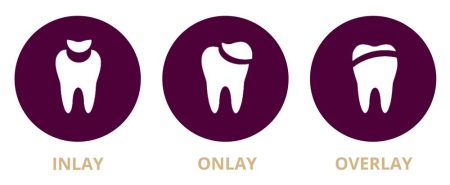
Inlays, onlays and overlays are today one of the best ways to restore teeth affected by caries, especially larger parts of the tooth. They are ceramic inserts that will perfectly replace the missing part of the tooth.
An inlay, onlay, or overlay provides greater durability and strength to the filling.
Ceramic fillings are made in the laboratory using the CEREC digital protocol and precise CAD/CAM technology. Today’s digital processes allow inlay, onlay or overlay fillings to be made much faster than before, which means that you will be able to have several ready-made ceramic fillings in one visit to the dentist.
Endodontic dental treatment
In the event of involvement of the dental pulp, endodontic treatment of the tooth will be necessary in addition to crown reconstruction.
Since involvement of the dental pulp most often means greater loss of the dental crown, but also due to the loss of tooth vitality, the remaining part of the dental crown needs to be protected with a prosthetic dental crown.
Read more on the page about endodontic treatment.
Guidelines, consensus reports and official positions of professional societies
Dhar V et al. (2023). Evidence-based clinical practice guideline on restorative treatments for caries lesions: a report from the American Dental Association. J Am Dent Assoc. An American Dental Association guideline with 16 recommendations for the treatment of moderate and advanced carious lesions in vital, non-endodontically treated teeth. https://www.ada.org/resources/research/science/evidence-based-dental-research/caries-management-clinical-practice-guidelines/evidence-based-clinical-practice-guideline-on-restorative-treatments-for-caries-lesions/
Schwendicke F et al. (2016). Managing carious lesions: consensus recommendations on carious tissue removal. Adv Dent Res. Consensus of the International Caries Consensus Collaboration. Entry into the restorative cycle should be delayed as long as possible, and when a filling is indicated, the priorities are preserving healthy and remineralisable tissue, achieving a seal, maintaining pulp health and ensuring the longevity of the restoration. https://doi.org/10.1177/0022034516639271
Systematic reviews and meta-analyses
Fernández E et al. (2026). Clinical longevity of direct dental restorations: an umbrella review of systematic reviews. J Esthet Restor Dent. Sixteen systematic reviews and meta-analyses published between 2012 and 2025, covering more than 15,000 restorations with follow-up of 6 to 120 months. Conventional composites showed survival above 90% after 5 years, especially with multi-step adhesive systems. Bulk-fill composites give comparable short- and medium-term results, with failure rates below 7%, but there are not yet enough long-term data. https://doi.org/10.1111/jerd.70052
Opdam NJM et al. (2014). Longevity of posterior composite restorations: a systematic review and meta-analysis. J Dent Res. An analysis of 2,816 restorations from 12 longitudinal studies with at least 5 years of follow-up. The main reasons for failure were secondary caries and fracture, and patients at high caries risk and restorations involving several tooth surfaces had a significantly higher risk of failure. A reference paper explaining why the longevity of a filling depends on the patient as well, not only on the material. https://pubmed.ncbi.nlm.nih.gov/25048250/
Lewis SR et al. (2025). Restorative materials for the direct coronal restoration of permanent posterior dentition: an overview of systematic reviews. Cochrane Oral Health. A Cochrane review of the evidence on the effectiveness and longevity of materials for direct fillings in permanent posterior teeth, prepared in the context of the phase-down of amalgam. The abstract was published in 2025, and the full review is being published in the Cochrane Library. https://oralhealth.cochrane.org/news/mercury-free-restoration-materials-summary-evidence
Santos MJMC et al. (2025). Clinical longevity of complex direct posterior resin composite and amalgam restorations: a systematic review and meta-analysis. Oper Dent. For large multi-surface fillings, no statistically significant difference in failure rates was found between composite and amalgam. The most common reasons for failure of composite fillings were secondary caries and fracture of the filling or the tooth. https://pubmed.ncbi.nlm.nih.gov/40458903/
Tennert C et al. (2024). Longevity of posterior direct versus indirect composite restorations: a systematic review and meta-analysis. Dent Mater. Five randomised trials and 627 restorations. The annual failure rate was 0% to 5.4% for direct and 0% to 15.5% for indirect composite restorations, with a statistically significantly lower failure rate for direct fillings. The level of evidence is very low. https://pubmed.ncbi.nlm.nih.gov/39122602/
Huang X et al. (2025). The clinical performance of high-viscosity glass ionomer-based and bulk-fill resin-based restorations in permanent teeth with occlusal or proximal cavities: a systematic review and meta-analysis. Clin Oral Investig. A comparison of high-viscosity glass ionomer and bulk-fill composite fillings in occlusal and proximal cavities of permanent teeth. https://doi.org/10.1007/s00784-024-05371-3
Factors affecting the longevity of fillings
Santos MJMC et al. (2024). Multifactorial contributors to the longevity of dental restorations: an integrated review of related factors. Dent J 12(9):291. A review of tooth-, patient- and dentist-related factors that affect the lifespan of direct restorations. It notes that roughly half of all fillings placed in general practice are in fact replacements of existing, failed fillings. https://doi.org/10.3390/dj12090291
Book an appointment at Apolonija Dental Clinic by phone, via WhatsApp or using the contact form.
+385 1 4883 800 +385 91 4883 800